Learning Hub
Learn to drive safely on motorways. Understand signs, road markings, stud colours, and their meanings to navigate high-speed roads with confidence.
Understanding motorway signs is crucial for safe high-speed driving. Here are the most important signs you'll encounter.

Indicate mandatory instructions. For example: minimum speed limit, lane directions, or keep left except overtaking.

Primary route information: junctions, destinations, distances. Green backgrounds denote motorways.

Triangular with red border. Warn of hazards ahead: lane closures, queues, fog, or roadworks.
Motorway road markings provide critical information about lane usage, separation, and hazards. Knowing these can prevent accidents.

In the UK, reflective road studs (commonly called "cat's eyes") are used to mark lanes and provide guidance in low visibility. Each colour has a specific meaning.
Marks the centre of the road or lane dividers on dual carriageways and motorways.
Indicates the left edge of the road on dual carriageways and motorways.
Marks the right edge of the road on dual carriageways and motorways (central reservation side).
Indicates slip roads, junctions, and lay‑bys. Also used at exits and entrances.
These colours are especially helpful at night or in poor weather, providing a clear visual guide to the road layout.
Understanding how Smart Motorways work, their benefits, and safety considerations.
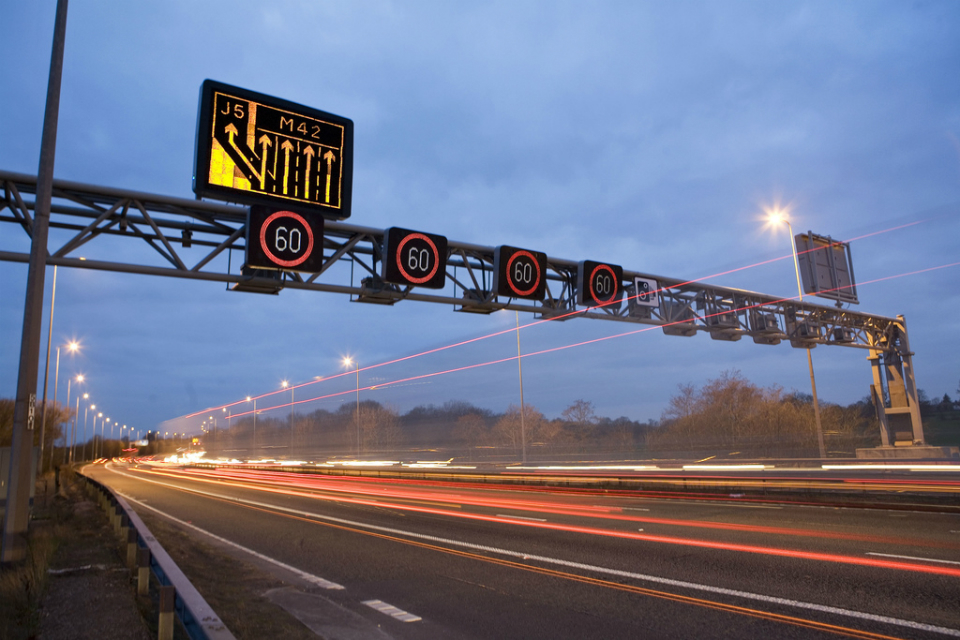
Smart Motorways are sections of motorway that use technology to manage traffic flow and reduce congestion. They do this by actively monitoring traffic and dynamically changing speed limits, opening and closing lanes, and using the hard shoulder as an extra lane during busy periods.
There are three main types of Smart Motorways:
These systems rely on cameras, sensors, and overhead gantries to display mandatory speed limits and lane closures.

Driving on a Smart Motorway requires extra attention to overhead signs and signals. Here are key safety points:
Smart Motorways are designed to improve traffic flow and reduce journey times, but they require drivers to be more vigilant and responsive to changing conditions.
Essential guidance for lane discipline, overtaking, and staying safe when driving on motorways at night.
You should always make an effort to drive in the left-hand lane unless slower traffic ahead means you need to overtake (move to lane 2). Similarly, if you need to overtake traffic in the middle lane, use the outside lane (move to lane 3).
You can also move to the right if you have an approaching junction ahead, and traffic will merge from a slip road on your left side. Noticing a junction ahead will help you to move lanes in good time.
Always use your indicators to show other drivers of your intentions and only overtake when it’s legal and safe to do so. Under no usual circumstances, ever overtake on the left (also known as undertaking). This could be classed as dangerous driving. There is only one exception where you are allowed to overtake on the left, and this is when all lanes of traffic are moving slowly, but the left lane is moving slightly faster. You will come across this if there are highway works in the area, but don’t start weaving in and out of your lane just to get ahead. A few extra seconds of holding back will not affect your overall journey time. Better to arrive safely.
Once you have safely overtaken, you should move back into the left lane. Driving only in the middle lane (hogging) is not only bad form; it is an offence that could leave you with penalty points on your licence.
Take extra care if you are moving from the right-hand lane towards the left. There might be a car driving from the left-hand lane to the middle simultaneously. Always check all mirrors and remember to indicate your intention before moving.

Using a motorway at night has the added risk of tiredness and reduced visibility. Some motorways are not lit at night, making it more challenging to see.
To stay safe, you must make sure your headlights are on at least 30 minutes after sunset and keep them on until 30 minutes at least before sunrise. Some drivers with automatic lights may have to adjust them manually.
You should always switch your lights on when visibility is reduced below 100 metres due to rain, snow or fog. When using fog lights, please remember to switch them off once you are in clear visibility, as these lights are incredibly bright and can dazzle drivers behind you.
Tiredness on the motorway can be incredibly dangerous, and the Highway Code states you should take a break of at least 15 minutes every 2 hours you drive. It is always better to arrive safely and avoid any possibility of falling asleep behind the wheel, especially as motorway driving can be pretty monotonous.
Motorway service stations are purposedly spaced between one another to ensure drivers have the opportunity to take a break safely. You should generally never be any more than 30 minutes away from services at any point on busier motorways. Use these services regularly, even if pulling over to just stretch your legs.

You've mastered the basics of Motorways. Now it's time for something new.